Valve Testing Machines and Valve Test Benches

A factory-direct range of hydraulic valve test equipment, engineered around your valve type, size range and test pressure.

How we select a machine

The machine follows the valve, not the other way round

Buyers often ask for a price first and a specification second. That order does not work for valve testing machines, because two factories testing the same nominal valve size can need completely different equipment. The machine is derived from the valve: its type and body geometry, the size range you actually run, the test pressure the standard demands, the test media, the number of test stages in one cycle, and how many valves pass across the bench in a shift. A DN80 soft-seated ball valve tested on air at low pressure and a DN300 cast steel gate valve tested hydrostatically at 1.5× rating are not the same machine with a different paint colour. They differ in clamping force, platen travel, sealing arrangement, pump duty, pipe bore, instrumentation class and safety guarding.

KANGYUAN has built these machines for more than 20 years as a factory-direct manufacturer, so we start every enquiry from your valve data and work outwards. In practice that leads to one of three machine configurations, each with a clear job:

  • Valve pressure test machine — a vertical hydraulic press frame that clamps the valve between two sealing platens and applies shell, seat and backseat test pressure. Best suited to gate, globe, check and other valves that are tested upright, particularly larger and heavier bodies.
  • Valve test bench — a horizontal bench with one or two independent stations, a compact hydraulic power unit and a digital pressure console. Suited to smaller valves, higher throughput and workshop bays with limited headroom.
  • Valve testing equipment — skid-mounted multi-station systems that combine pump, tank, manifold, instrumentation, controls and data logging in a single package. Suited to production testing, safety valve work and customers building a new test bay from scratch.

Everything that touches the valve — platen size, sealing plate, flange adapters, clamping stroke, clamping force and control level — is made to your drawings. Send us the data and we will tell you which series fits, and why.

Product range

Six machine series, one engineering standard

Every series is built to order around your valve type and size range. The full model tables and published pressure data for the KY, KY-A and KY-T series are on their own pages.

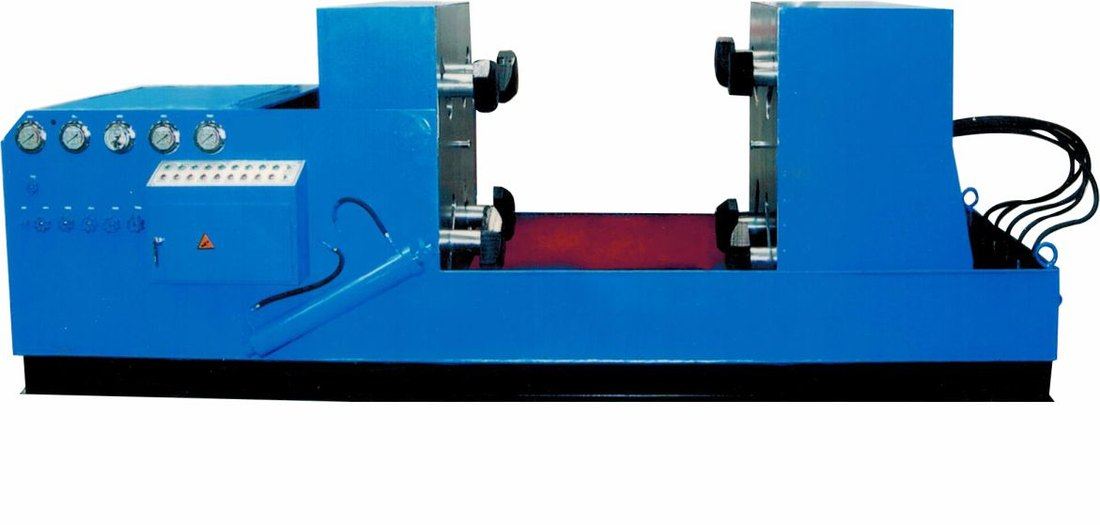
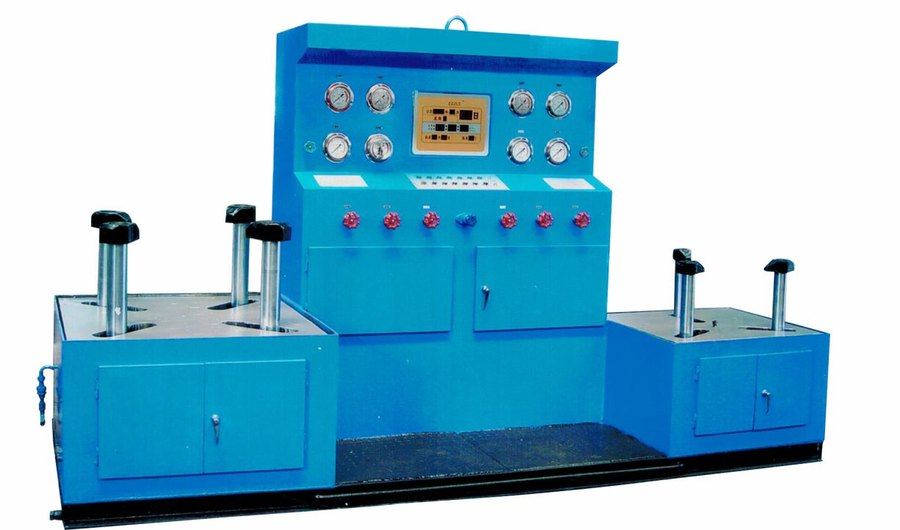
KY series hydraulic valve test bench with flange-face sealing heads and clamping jaws
KY-100 – KY-1000

KY Series Hydraulic Valve Test Bench

The core series for flanged straight-through valves in DN15 to DN1000. Sealing is on the flange end faces and clamp jaws grip the back of the flange, so the test result is not affected by external force, and the valve can be turned through 90° during the test for gas seat testing.

KY series valve test bench details →
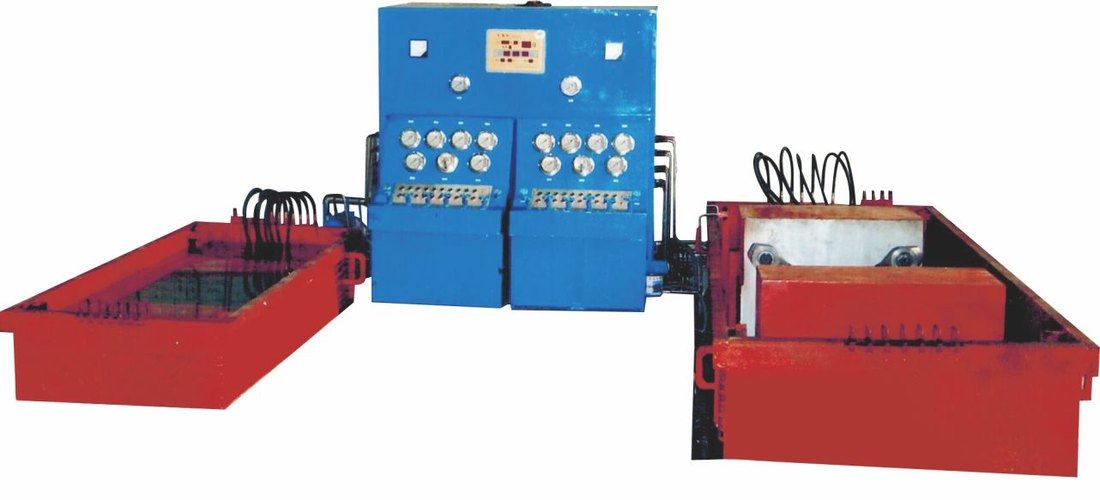
KY-Z series immersed hydraulic valve test bench with blue control console and two red water pools
KY-Z immersed

KY-Z Series Immersed Valve Test Bench

The pump station, control console and clamping table are connected on site as one system, and the valve is lowered into a water pool for the test. The clamping table turns through 90°, which makes the machine particularly suitable for gas pressure testing.

KY-Z immersed bench details →
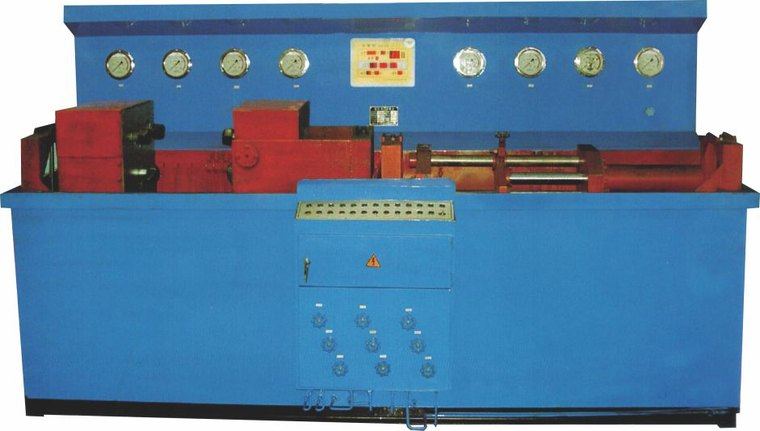
KY-Z series combined small-caliber immersed valve test bench with water tank and clamping table
KY-Z small caliber

KY-Z Series Combined Small-Caliber Immersed Test Bench

The small-caliber member of the immersed family, arranged as a combined unit for the valve sizes a workshop tests most often. Parameters for this series are confirmed against your size range at quotation.

KY-Z immersed bench details →
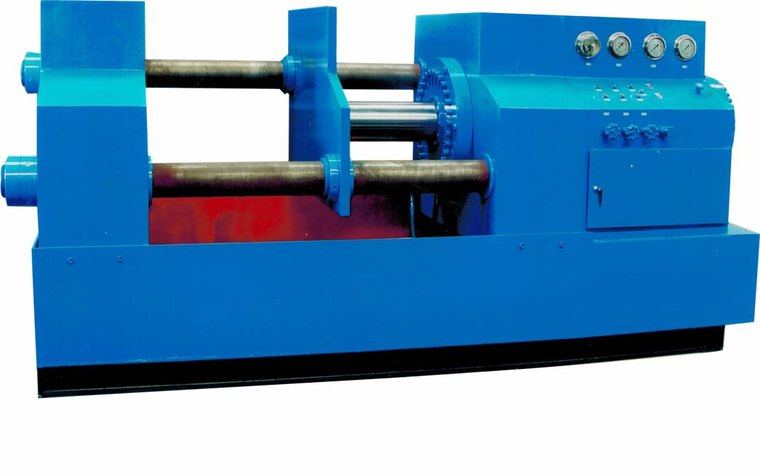
KY-A series large-caliber power-station valve test bench with hydraulic clamping heads
KY-A/100 – KY-A/800

KY-A Series Large-Caliber Power-Station Valve Test Bench

A large-caliber bench for power-station valves with welded or threaded ends, DN15 to DN800. Sealing is on the valve end openings, the water circuit is rated to 50 MPa on the smaller models and the effective opening reaches 1550 mm.

Power-station valve test bench details →
KY-T series hydraulic butterfly valve test bench with synchronous wrapping clamp jaws
KY-T300 – KY-T2000

KY-T Series Hydraulic Butterfly Valve Test Bench

A bench for DN50 to DN2000 flanged and wafer butterfly valves, with synchronous wrapping jaws. Body and seat pressure, disc opening and closing travel and electric actuator torque are tested on the same machine.

Butterfly valve test bench details →
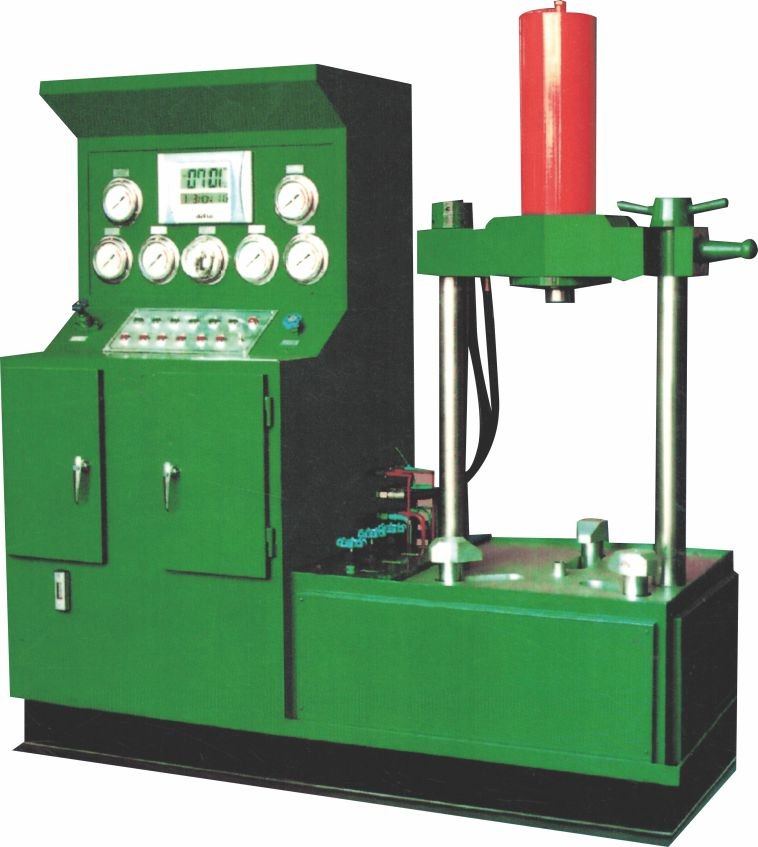
KY-B vertical hydraulic valve test bench with green control cabinet and red clamping cylinder
Vertical frame

KY-B Series Vertical Hydraulic Valve Test Bench

A vertical machine for flanged, welded and threaded valves that works with clamp jaws or top-pressure clamping. The upper cross beam swings back 90° to clear the loading position, and water, air or kerosene can be used as the test medium.

KY-B vertical valve test bench details →
Auxiliary machines

Equipment that supports the test benches

Workshop equipment supplied alongside the test benches, configured for the valve sizes and the line layout you work with.

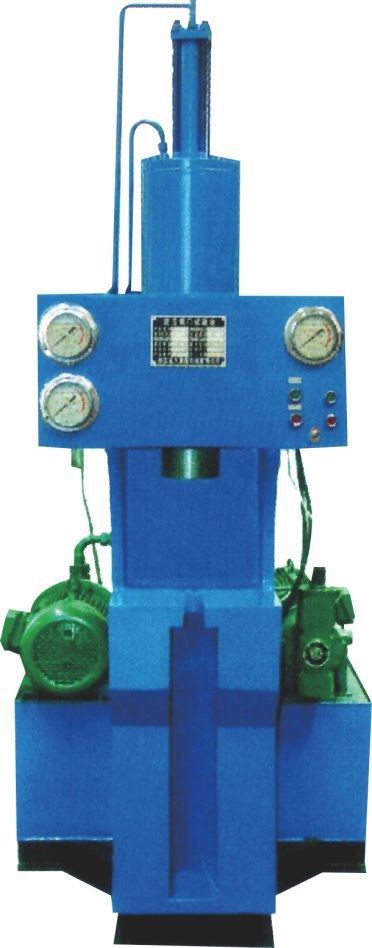
KY-L hydraulic hammer from the KANGYUAN auxiliary equipment range
KY-L

KY-L Hydraulic Hammer

Auxiliary equipment from the same range, built for the workshop work that goes with valve testing and reconditioning. Tell us how you want it configured and we will confirm the specification with the quotation.

Specialist equipment details →
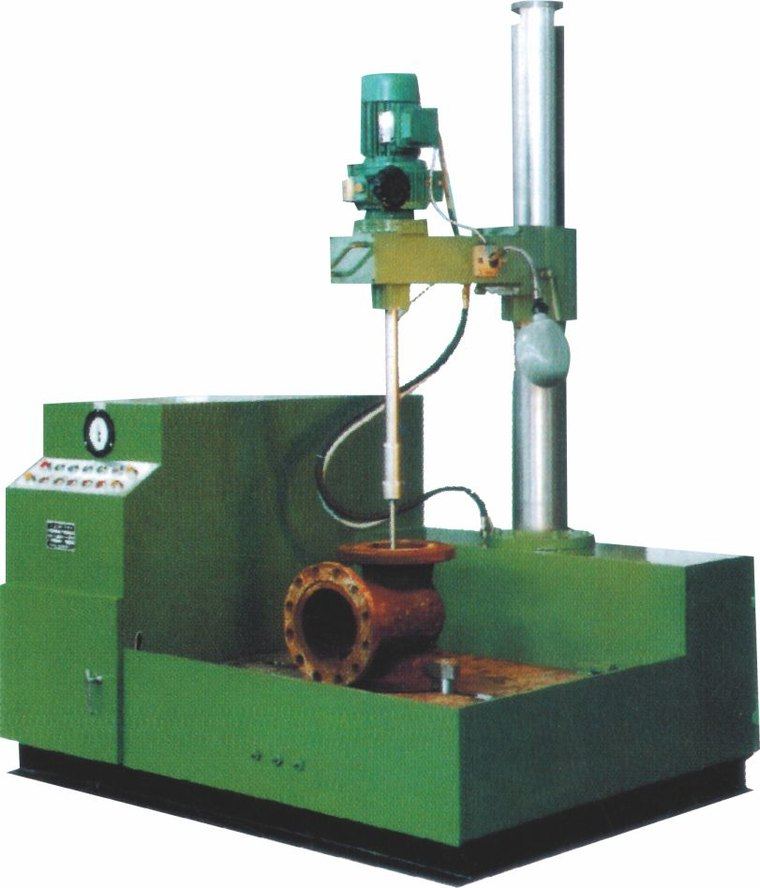
Hydraulic valve grinder from the KANGYUAN auxiliary equipment range
KY grinder

Hydraulic Valve Grinder

A hydraulic valve grinder for reconditioning sealing faces alongside the test benches, so a valve that fails its seat test can be worked on in the same bay. Options and specification on request.

Specialist equipment details →
Automated pipeline clamping machine for valve and pipeline assembly work
Automated clamping

Automated Pipeline Clamping Machine

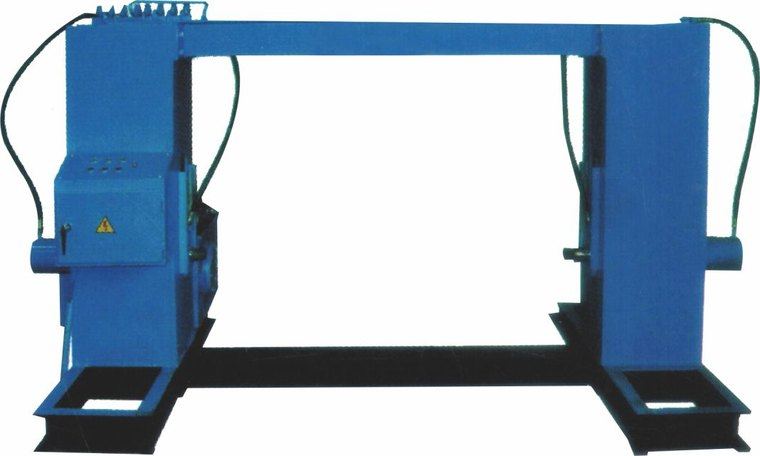
Clamping equipment for automated valve and pipeline work, configured per project around the valve sizes and the line layout. Ask us for the arrangement that suits your workshop.

Specialist equipment details →
Choosing between them

Series comparison

The published range of every series, from the current KANGYUAN catalogue. Valve sizes and pressures below are catalogue data, not fixed limits.

Footnote: catalogue data. The final specification of each machine is confirmed against your valve list at quotation.

Published series data for KANGYUAN valve test machines. Catalogue values; the final specification is confirmed at quotation.
Series Models Valve size range (DN) Published pressure data Working method
KY Series Hydraulic Valve Test Bench KY-100, KY-200, KY-300, KY-400, KY-500, KY-600, KY-800, KY-1000 DN15 to DN1000 (KY-100 DN15-100 to KY-1000 DN500-1000) PN 1.0-32 MPa; pressure regulation 0-6.3 MPa; boost pressure 3.0-31.5 MPa; oil pump 0-5.0 MPa Flange end-face sealing with clamp jaws gripping the back of the flange; the valve can be turned 90° during the test; water, air or kerosene as the medium.
KY-Z Series Immersed Hydraulic Valve Test Bench KY-Z Confirmed at quotation Confirmed at quotation Pump station, control console and clamping table connected on site; the valve is immersed in a water pool and the clamping table turns through 90° for gas pressure testing.
KY-Z Series Combined Small-Caliber Immersed Test Bench KY-Z Confirmed at quotation Confirmed at quotation Combined small-caliber immersed bench for the valve sizes a workshop tests most often; water and air as the test media.
KY-A Series Large-Caliber Welded/Threaded Power-Station Valve Test Bench KY-A/100, KY-A/200, KY-A/300, KY-A/400, KY-A/500, KY-A/600, KY-A/800 DN15 to DN800 (KY-A/100 DN15-100 to KY-A/800 DN400-800) Max. valve pressure at nominal size 32.0 MPa (KY-A/100, KY-A/200) down to 4.0 MPa (KY-A/800); water pump to 50.0 MPa on KY-A/100 to KY-A/500; cylinder 31.5 MPa Sealing on the valve end openings for welded and threaded ends; effective opening 750-1550 mm maximum and 120-500 mm minimum; oil pump 0-6.3 MPa.
KY-T Series Hydraulic Butterfly Valve Test Bench KY-T300, KY-T600, KY-T800, KY-T1000, KY-T1200, KY-T1600, KY-T2000 DN50 to DN2000 (KY-T300 DN50-300 to KY-T2000 DN1200-2000) Max. valve pressure at nominal size 4.0 MPa (KY-T300, KY-T600) down to 1.0 MPa (KY-T1600, KY-T2000); water pump 10.0 MPa; cylinder 31.5 MPa Synchronous wrapping jaws, single-jaw or combined sleeve type, on flanged and wafer butterfly valves; body and seat pressure plus disc travel and electric actuator torque.
KY-B Series Vertical Hydraulic Valve Test Bench KY-B Confirmed at quotation Confirmed at quotation Vertical frame with clamp-jaw or top-pressure clamping, upper cross beam swinging back 90°; flanged, welded and threaded valves; water, air or kerosene as the medium.
Configuration

Shared engineering options

The six series share the same building blocks. These are the choices that shape a quotation.

Sealing and clamping options

Quick-change seal plates let one machine cover several valve sizes without a long changeover, and flange adapters handle non-standard bolt circles and raised or flat faces. Soft seals suit soft-seated and lapped-seat valves where the sealing face must not be marked; metal or hard-faced seals are used where pressure, temperature or abrasive media rule out elastomers. Clamping stroke, platen diameter and clamping force are set from your valve drawings.

Pressure and control options

Control can be as simple as manual valves with a calibrated master gauge, or as complete as a semi-automatic PLC cycle, a recipe-driven HMI where the operator selects the valve model and the pressures load automatically, and data logging that stores each test against a valve serial number. Recipe-driven control is the usual choice when several valve types are tested on the same machine.

Test media options

Water with a rust inhibitor is the standard medium for hydrostatic and seat leakage testing and is normally the customer's supply on site. An air or nitrogen circuit is added for low-pressure leak testing of soft-seated valves, with the appropriate pressure reduction and safety shielding. A separate hydraulic oil circuit can be included where a customer tests with oil or needs an independent circuit from the water side.

Scope

What is not in the standard package

A clear scope boundary saves arguments later. The machine arrives complete and function-tested in our workshop, but a few items sit outside the standard supply because they depend on your building, your utilities or your inspector. These are quoted as options when you want us to arrange them, or handled by you or your local contractor.

  • Foundation and pit work — civil design, excavation, concrete and anchor grouting for larger frames and skids, usually carried out locally to our foundation drawing.
  • Water supply and drainage — filling the tank, topping up, and routing the drain from the test area.
  • Compressed air — a clean, dry air supply at the pressure and flow the pneumatic clamps or air test circuit require.
  • Three-phase power — the supply to the machine, including the isolator and cable from your distribution board, sized to the motor and control ratings in the proposal.
  • Third-party inspection — where your customer appoints an inspection agency, the agency's fees and attendance are arranged and paid by the buyer, and we support the inspection with test records and access.
  • On-site commissioning travel — installation guidance and remote support are included; if you want our engineer on site for commissioning or operator training, travel, accommodation and labour are quoted separately.

Listing these openly is not a limitation of the machine. It means the quotation you receive covers the equipment, and the items that depend on your site are visible from the start rather than appearing later.

Specification checklist

How to specify your machine

Send these seven points and we can move from an indicative price to a firm technical proposal quickly. Drawings or photographs help, but they are not a substitute for the numbers.

  1. Valve type and design. Gate, globe, check, ball, butterfly, plug, safety and relief, control or wellhead — and whether the body is cast, forged or fabricated, since that affects how it can be clamped and sealed.
  2. Size range and end connections. The smallest and largest size you will actually test, plus flange standard, facing type and any non-standard bolt circles. A machine sized for the largest valve is usually the correct choice, but the range tells us whether one sealing plate can cover it.
  3. Test pressure and test stages. Shell test pressure, seat test pressure in each direction, backseat pressure and any low-pressure air or gas test, together with the hold time you apply at each stage.
  4. Standard and acceptance criteria. The standard you quote to, for example API 598, ISO 5208, API 6D, EN 12266 or your own factory procedure, and the leakage acceptance limits agreed with your customer.
  5. Throughput and station count. Valves per shift, average test duration, and whether one operator or several will use the machine. This drives the choice between one station, two stations and a multi-station skid.
  6. Control level and records. Manual, semi-automatic PLC, recipe-driven HMI, and whether you need data logging, CSV export or printed test certificates for each valve serial number.
  7. Site conditions. Available three-phase power, water supply and drainage, compressed air, headroom, floor area, crane or hoist capacity and whether the machine must fit a container or a specific bay position.

Read the frequently asked questions → or see which valves and industries we build for →.

Tell us your valve data, get a machine proposal

Send the size range, test pressure and standard. We will confirm the right machine family and the specification in writing.

Contact us kangyuangroup@gmail.com WhatsApp +86 187 5776 5223